
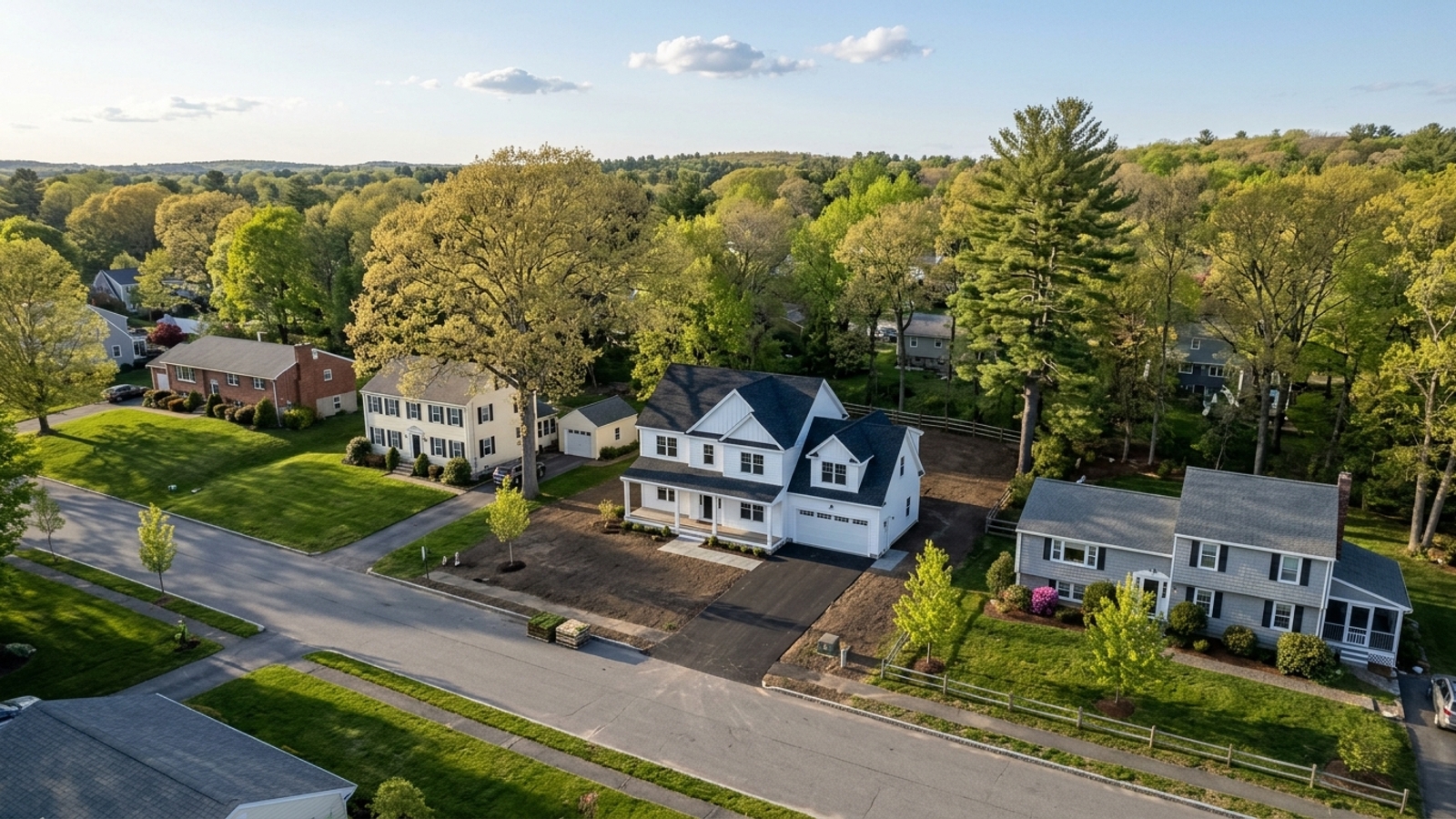
Finding an empty lot in Needham is rare. Buyers who want to build typically purchase an existing house to tear down, which makes land acquisition the largest hurdle in the whole process.
The project involves buying the land, clearing the site, and funding the construction. Confirming the local zoning limits and demolition rules before you make an offer saves you from buying a property you can’t build on.
Key Takeaway
In a town with little vacant land, building your own home in Needham usually starts with buying an existing house to replace, making the lot your first and largest cost. Single-family prices are down from a year ago, which gives buyers more room to negotiate that initial land purchase. If you’d rather skip the demolition and building phases, buying a finished new-construction home from a local builder is the main alternative.
Who This Guide Is For
You’re deciding whether to buy a Needham lot or teardown and build new, or to buy a home that’s already finished.
Is It Cheaper to Build or Buy a Home in Needham?
In Needham, building your own home is mostly a land purchase. With single-family prices down year over year and 2.5 months of supply, the house you’d tear down is more negotiable than it was a year ago. Because finished single-family homes already trade at a median price per square foot (see At a glance), the build only wins when the lot plus demolition plus construction comes in under that benchmark for the house you want. Prospective builders often review Needham housing market trends to help weigh these initial expenses.
Most new houses go up where an older one stood. Needham’s quarterly reports of building permits issued routinely show demolition and new-dwelling permit activity happening in tandem. The costs break down into the lot purchase, demolition and site prep, soft costs like architectural and engineering fees, the physical construction, and carrying costs during the build. Custom home construction in the Greater Boston area runs roughly $500 to $1,000 per square foot in 2026, with luxury builds running higher.
For illustration only: a 4,000-square-foot finished home at the single-family median price per square foot works out to about $2,136,000. You add your lot price, demolition estimate, and builder’s per-square-foot quote together and compare that total to the benchmark. If your lot plus the build exceeds it, you’re paying a premium for customization.
The town median blends older and newer homes, so new construction usually commands more per square foot. Get recent new-construction sales comps from an agent before trusting the benchmark alone.
How to Build a Home in Needham, Step by Step
Building a house means coordinating land acquisition, local approvals, and specialized financing. You’re running a small development project, and the sequence matters. Securing a lot and confirming what you can build on it has to happen before you finalize house plans or hire a construction crew.
Find a Lot or Teardown
You’re searching for a house you’ll replace, priced like any other house on the market. With single-family median sale prices down year over year in late 2026, there’s room to negotiate on a dated property whose value is mostly in the land. Ask a real estate agent about neighborhoods where teardowns are common.
That said, you pay full market price for a house you plan to demolish. With a third of single-family homes still selling above list price, the best lots draw competing offers. Your budget ceiling needs to account for demolition and construction on top of the purchase price.
Check Zoning and House Size Limits Before You Buy
The lot dictates the house size, so don’t skip this step. Under Needham’s Table of Dimensional Regulations, the Single Residence A (SRA) District requires a minimum lot area of 43,560 square feet and 150 feet of frontage, with 30-foot front, 25-foot side, and 15-foot rear setbacks. The Single Residence B (SRB) District requires a minimum lot area of 10,000 square feet and 80 feet of frontage, with 20-foot front, 12.5-foot side, and 10-foot rear setbacks. Both districts set a 35-foot height limit (2.5 stories), though a footnote caps the maximum height at any point at 41 feet above grade in SRB and General Residence districts.
Ask the town for the parcel’s zoning district and get a certified plot plan from a surveyor before your offer is final. A lot can cap the house smaller than the one you sketched, and an undersized or nonconforming lot may need zoning relief that adds months and is never guaranteed.
Plan for Demolition Review and Site Prep
Taking the old house down requires its own set of approvals, and they can slow things down considerably. Needham’s General By-Laws give the Historical Commission authority to review proposed demolition projects, which can impose a six-month demolition delay if the house is found historically significant. You also need a thorough pre-demolition survey for asbestos under MassDEP regulations, and the agency requires notification at least 10 working days before demolition starts.
Needham also protects overstory trees measuring 40 feet or more at maturity located in a property’s unbuildable perimeter setbacks. A 2026 bylaw requires replacement or a mitigation fee if you remove these trees, with a 12-month look-back period before a construction permit is pulled.
Order an asbestos survey and ask the Historical Commission whether the house is subject to demolition delay review before your inspection contingency expires. If the house is flagged for review, a six-month delay can stall your schedule while you’re already carrying the lot. Asbestos removal is a cost you won’t know until the survey is done.
Choose an Architect and Builder, or Pull Permits Yourself
Massachusetts lets you pull a building permit for your own one- or two-family home under the homeowner exemption (780 CMR). An architect and a professional holding a Construction Supervisor License are the standard alternative. Verify any builder’s license and Home Improvement Contractor registration on the state website.
Rob Ticktin of Hawthorn Properties holds a Massachusetts Construction Supervisor License and Home Improvement Contractor registration and can help size up a teardown before you bid.
Acting as your own builder puts code compliance, subcontractor scheduling, and liability on you. Under the homeowner exemption, the owner takes responsibility for the work and loses access to the state arbitration program and guaranty fund.
Finance the Land and the Build
Land and construction are often financed differently than a standard mortgage. Construction-to-permanent loans expect more cash down; Needham Bank, for example, requires a minimum 15% down payment on the sales price or as-is value at closing, and you must have at least 20% equity based on the total borrowed amount and the property’s appraised as-complete value.
You’ll pay carrying costs during the build, including loan interest, insurance, and property taxes on the lot. Get construction loan terms, draw schedules, and down payment requirements from at least two lenders. Compare your current property tax bill to estimate costs, and think through selling strategies if you plan to fund the build by selling a current home. Construction overruns typically come out of your cash reserves rather than the loan.
Get Permits, Pass Inspections and Move In
Before breaking ground, you’ll pay permit fees and submit plans proving the house meets the Opt-In Specialized Energy Code, which Needham adopted for new construction effective July 1, 2024. The town conducts staged inspections throughout the build, culminating in a certificate of occupancy.
Ask the building department for current permit review times and fees for a new dwelling, and build those timelines into your loan and lease dates. A stricter energy code adds cost to the build, and a failed inspection or slow review pushes back the move-in date your financing and housing depend on. Ask the assessor how a new house will change your property assessment.
When Buying a Finished Home Makes More Sense
Buying a finished new-construction home from a local builder lets you skip demolition and permitting. You take the builder’s floor plan and price, but you avoid managing the project yourself. Ask a builder selling a finished home for its warranty terms. If you already own property in town, rebuilding or adding on to your current lot removes the land purchase from the math entirely.
Townhouses offer newer, lower-maintenance space without the project management. The townhouse median sale price rose 21.3% year over year to $1,432,517, based on only 10 townhouse sales, so treat the change with caution; with just three active listings recently on the market, the townhouse market is too thin to treat as a fallback you can count on. Buying finished means accepting someone else’s layout and, for new construction, paying the builder’s margin.
How to Decide Whether to Build or Buy in Needham
Do you already own a house in Needham? If so, rebuilding on your own lot removes the land purchase from the math. Start by checking zoning and house size limits, and weigh that against renovating your current space.
Will the house you want fit the lot’s zoning limits? If you have not checked the floor area, height, and setback rules for a specific parcel, do that before making any offer. Can you carry the lot, the construction loan, and your current housing at the same time until the new house is finished? If not, review the financing steps or skip ahead to buying finished. Finally, check whether your lot-plus-build total comes in under what a comparable finished home would cost at the town’s median price per square foot. Hawthorn Properties can walk a prospective lot with you and pull recent new-construction sales for comparison.
At a Glance
- Single-family median sale price: $1,709,319, down 7% year over year (90 days ending 2026-09-30)
- Single-family median price per sq ft: $534 (90 days ending 2026-09-30)
- Single-family homes sold: 85; median days on market: 26; sale-to-list: 99.6%; sold above list: 33.3% (90 days ending 2026-09-30)
- Single-family months of supply: 2.5; active inventory: 69 (90 days ending 2026-09-30)
- All homes median sale price: $1,591,742, down 7% year over year; median price per sq ft: $528; 104 sold; median days on market: 32; months of supply: 2.3 (90 days ending 2026-09-30)
- Townhouse median sale price: $1,432,517, up 21.3% year over year, based on only 10 townhouse sales, so treat the change with caution; median days on market: 56; sale-to-list: 97.9%; inventory: 3; months of supply: 1; median price per sq ft: $489 (90 days ending 2026-09-30)
Building a Home in Needham FAQs
Why Is Building a Home in Needham so Expensive?
Land in Needham typically comes with an existing house that you purchase at full market value before demolition begins. On top of that land cost, Needham’s quarterly building permit reports show that most new dwellings replace demolished structures, and construction costs in the Greater Boston area are among the highest in the country.
Can I Legally Build My Own House in Massachusetts?
Yes, under 780 CMR, a building permit can be issued to a homeowner doing work on the single- or two-family dwelling where they reside. This is an exception to the normal requirement that permits go to a licensed construction supervisor. Needham’s application materials state that homeowners who obtain their own permit lose access to the state arbitration program and guaranty fund, so confirm the current rules with the building department.
How Much Does It Cost to Build a 2,000 Sq Ft House in Massachusetts?
At the 2026 Greater Boston range of $500 to $1,000 per square foot (see Is it cheaper to build or buy?), construction alone for a 2,000-square-foot house runs roughly $1,000,000 to $2,000,000, excluding land, demolition, and soft costs like architectural fees. Get specific quotes from local builders for your exact floor plan.
How Long Does It Take to Build a House in Needham?
The timeline depends on local approvals, including a potential six-month demolition delay if the Historical Commission reviews your teardown. Construction duration varies widely by builder and project scope. Ask your contractor for a written schedule that accounts for local permit review times and staged inspections.
Is It Cheaper to Build Up or Out on a Needham Lot?
It depends on your specific parcel’s zoning constraints. In the Single Residence B district, you face a 20-foot front setback, 12.5-foot side setback, and 10-foot rear setback, which limits how far you can build out on a tight lot. Building up is capped by a 35-foot height limit (2.5 stories), with a footnote restricting the maximum height at any point to 41 feet above grade, so check your lot’s specific dimensions before designing.
Can I Add an Accessory Dwelling Unit When I Build in Needham?
Yes. Under the statewide Affordable Homes Act effective February 2, 2025, accessory dwelling units up to 900 square feet or half the principal dwelling’s floor area are allowed by right in single-family zoning districts. Needham updated its local bylaw to conform, allowing both attached and detached ADUs by right without an owner-occupancy requirement, provided they remain in common ownership with the main house.
What County Is Needham, MA in for Deed and Lot Records?
Needham is in Norfolk County. Property deeds, easements, and lot histories are recorded with the Norfolk County Registry of Deeds in Dedham, MA. The registry provides a free online research system available 24 hours a day, so have a title search done before closing on a lot.
Sources
- Redfin: Data Center
- Needham Table of Dimensional Regulations
- Needham Historical Commission
- MassDEP Asbestos Regulation FAQ
- Needham Tree Preservation Bylaw
- Needham Building Permits Issued
- Needham New Construction Application
- Needham Opt-In Specialized Stretch Energy Code
- Hawthorn Builders Custom Homes
- Needham Bank Construction-to-Permanent Mortgages
- Massachusetts Affordable Homes Act
- Norfolk County Registry of Deeds