
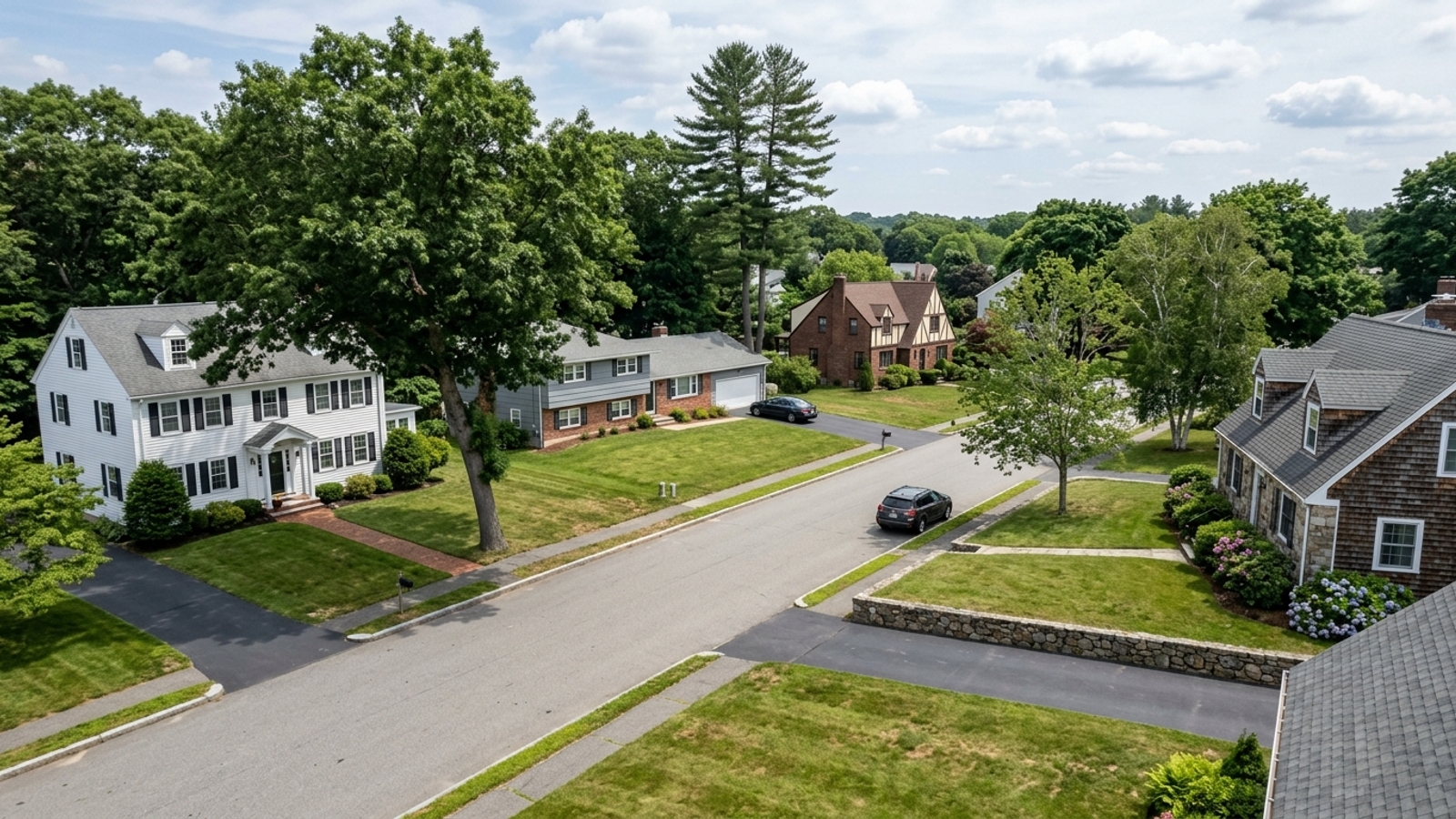
Buyers looking west of Boston often end up going back and forth between Needham and Wellesley. It’s an understandable place to get stuck when weighing the pros and cons of living in Needham, MA against Wellesley – both towns have real commercial centers, access to the Charles River, and direct commuter rail into the city. On paper, they look like close substitutes.
They’re not identical, though, and the differences matter once you start getting specific about lot size, commute, and what you’re willing to spend. What’s made this comparison trickier lately is that the traditional pricing relationship between the two has flipped. If you’ve been operating on assumptions from a few years ago, it’s worth starting fresh.
Comparing Real Estate Prices and Market Trends
Both markets are competitive right now – homes in both towns are routinely selling at or above asking price. In Needham, the median sale price has recently come in at roughly $1.69 million, with a median of just 21 days on market. Of the 118 homes sold, the average sale-to-list ratio landed at 100.47%. Wellesley is running its own strong numbers off a record-breaking 2025 that produced 302 closed transactions and nearly $746 million in total sales volume.
Home Prices and Market Shifts
Here’s the data point that surprises most buyers right now: for the first time in at least five years, Needham’s 2026 year-to-date median single-family sale price has overtaken Wellesley’s. Needham is sitting at $2.35 million; Wellesley is at roughly $1.89 million. That’s a meaningful reversal from 2024, when Wellesley single-family homes led by approximately $651,000.
Needham’s median price per square foot has reached $544, with a 4.1% annual appreciation rate that currently edges out Wellesley’s 3.8%. Wellesley still commands strong valuations – Zillow puts the town’s average home value at roughly $2.05 million as of mid-2026 – but the gap has closed considerably, and in the single-family segment, it’s now flipped entirely.
Property Taxes and Local Assessments
Tax rates are worth running the numbers on carefully, because the difference between these two towns is real. Needham’s Fiscal Year 2026 residential property tax rate is $10.83 per $1,000 of assessed value.
Wellesley applies a single uniform rate across all property classes – for Fiscal Year 2026, that rate is $10.17 per $1,000 of assessed value, a slight drop from the prior year’s rate of $10.28. Neither rate is low by any measure, but against a $2 million purchase price, that gap does show up in your monthly carrying cost.
Housing Styles and Lot Sizes
What you can build, how close you sit to your neighbor, and whether a teardown pencils out – all of that depends on which zoning district you land in. Both towns are land-constrained, so understanding the baseline rules before you fall in love with a specific property saves a lot of frustration later.
Zoning Rules and Lot Minimums in Needham
Needham’s residential zoning is district-specific, and the spread is wide. In the Rural Residence-Conservation (RR-C) and Single Residence A (SRA) districts, the minimum lot size is one acre – that’s 43,560 square feet.
Move closer to town and the thresholds drop considerably. The Single Residence B (SRB) and General Residence (GR) districts require a minimum lot area of 10,000 square feet. If your search is concentrated in a particular part of Needham, it’s worth pulling the zoning map before you start running renovation math.
Wellesley Lot Sizes and Property Guidelines
Wellesley has its own range, from historic estates to newer infill development. Town-wide averages shift depending on what’s traded recently, but individual property records in areas like Wellesley Hills tend to show typical residential lots around 12,000 square feet.
For buyers looking at teardowns or substantial additions, the specific parcel matters more than any neighborhood average. Established subdivisions with older property lines can constrain what’s buildable even on a lot that looks adequate on paper. Pull the actual records before you get too far down the planning road.
Commuting to Boston and Transportation Options
For most buyers, this section is where the decision gets practical fast. Both towns give you direct highway access and dedicated MBTA commuter rail – the question is which route lines up with where you’re going in the city, and which neighborhood within each town you’d be leaving from.
Driving Routes and Highway Access
Needham drivers have a few options: Route 128/I-95, Route 9, or the Mass Pike. In normal traffic, that’s roughly 25 to 45 minutes into Boston, depending on time of day and exactly where you’re headed.
Wellesley commuters lean on the Mass Pike (I-90). The distance into the city is comparable, but travel time is subject to the usual highway congestion and toll plaza slowdowns – no different from what Needham drivers deal with on their routes.
MBTA Commuter Rail Access
Needham is served by the MBTA Needham Line, running along the Franklin Line corridor. You can board at Needham Heights, Needham Center, Needham Junction, or Hersey – trips to Boston’s South Station via Forest Hills run about 30 to 35 minutes.
Wellesley sits on the MBTA Framingham/Worcester Line, with stops at Wellesley Square, Wellesley Hills, and Wellesley Farms. That line serves both South Station and Back Bay, with typical ride times of 30 to 40 minutes. If Back Bay is your destination, Wellesley’s rail connection is a genuine advantage.
Town Centers, Parks, and Local Amenities
The data tells you a lot, but spend an afternoon walking each town center before you make a decision. The day-to-day texture of a place – the coffee shop you’ll stop at, the park you’ll use on weekends, whether you feel like walking or always need a car – matters more over a ten-year ownership period than most buyers expect going in.
Shopping and Dining Districts
Wellesley Square packs a dense mix of retail, local boutiques, and restaurants into a relatively compact area. It sits right next to the Wellesley College campus, which means the arboretum is effectively built into the commercial district – it’s an unusual combination.
Needham Center has its own walkable concentration of local businesses, civic offices, and restaurants, clustered around the commuter rail stop. The layout is less dense than Wellesley Square but functions similarly as a daily errand hub for residents close to the center.
Parks and Outdoor Recreation
Needham has solid green space options: Rosemary Lake, the Needham Town Forest, High Rock Park, Memorial Park, and Cutler Park Reservation – a large state-managed park that runs along the Charles River.
Wellesley’s outdoor access includes Elm Park, Morses Pond, Longfellow Pond conservation land, and the Centennial Reservation, which adds trail networks for residents who want more than a neighborhood walk.
Frequently Asked Questions (FAQ)
What are the property tax differences between Needham, MA and Wellesley?
Needham’s Fiscal Year 2026 residential property tax rate is $10.83 per $1,000 of assessed value. Wellesley applies a single uniform rate across all property classes, set at $10.17 per $1,000 for Fiscal Year 2026. Run those exact rates against your target purchase price – the difference adds up at these price points.
How do home prices compare in Needham, MA vs Wellesley?
In the single-family segment, Needham’s 2026 year-to-date median sale price is $2.35 million, which now exceeds Wellesley’s median of roughly $1.89 million. Looking across all property types, recent MLS data puts Needham’s overall median sale price at around $1.69 million.
What are the main commuting options from Needham, MA and Wellesley to Boston?
Needham residents typically use the MBTA Needham Line – about 30 to 35 minutes to South Station – or drive via Route 128/I-95. Wellesley commuters use the Framingham/Worcester Line to reach South Station or Back Bay in 30 to 40 minutes, and frequently drive via the Mass Pike.
Which real estate market moves faster for buyers, Needham or Wellesley?
Needham is moving quickly – homes are spending a median of just 21 days on market and averaging 100.47% of list price at sale. Plan accordingly if you’re making offers there.
How do the downtown amenities and restaurants in Needham compare to Wellesley Square?
Wellesley Square is a dense retail and dining district positioned directly adjacent to the Wellesley College campus and arboretum. Needham Center offers a walkable mix of local shops and restaurants centered around its commuter rail station.
Are there different zoning rules or teardown restrictions when buying a lot in Needham versus Wellesley?
Yes. Needham’s minimums range from 10,000 square feet in General Residence zones up to a full acre in Rural Residence-Conservation areas, depending on the district. Wellesley lots vary by neighborhood – individual property records in areas like Wellesley Hills typically show sizes around 12,000 square feet. Pull the actual parcel data before committing to any renovation or teardown plan.